
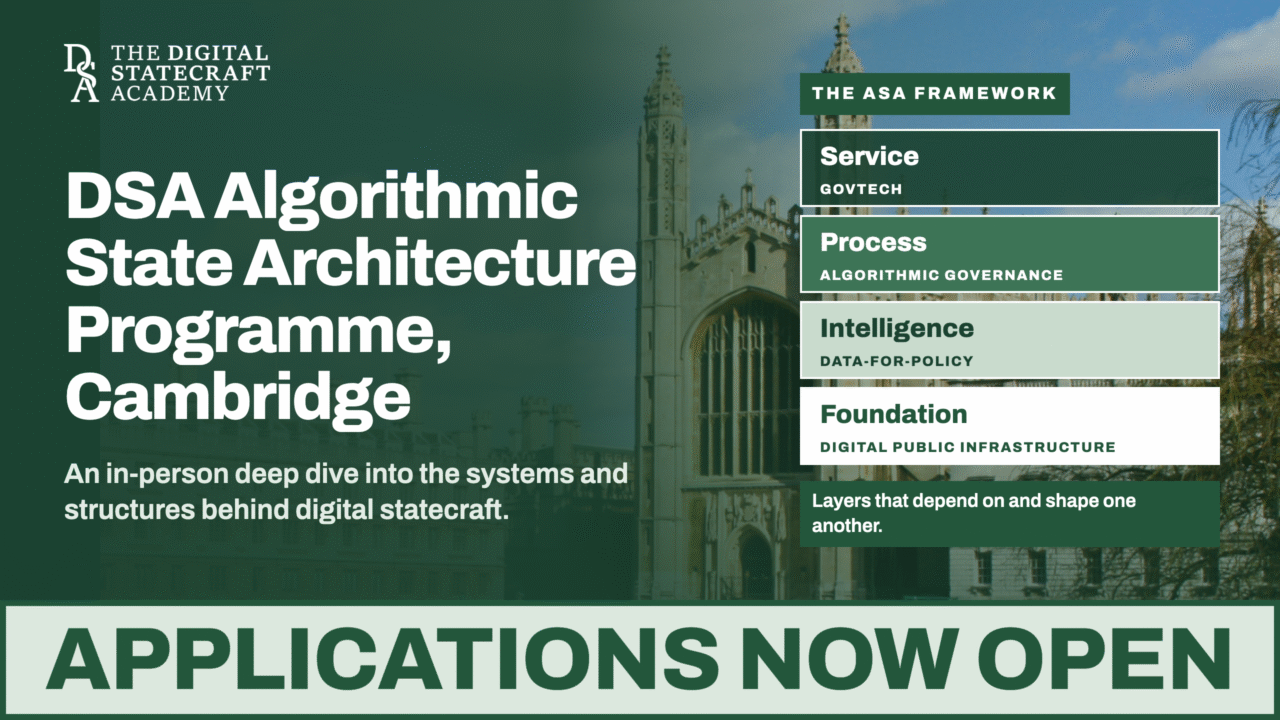
The Digital Statecraft Academy is opening applications for the DSA Algorithmic State Architecture Programme, Cambridge, a new one-week programme. It is a deep dive into the systems and structures behind digital statecraft.
Governments everywhere are under pressure to make AI-enabled transformation work as a coherent architecture that holds together end to end. Most training in this space offers a general survey of AI and data governance. This programme takes a narrower and more useful approach, built around DSA’s Algorithmic State Architecture (ASA) framework.
The framework treats the four domains at the centre of the challenge, digital public infrastructure, data for policy, algorithmic government and GovTech, not as parallel initiatives to be run separately, but as layers that depend on and shape one another. A failure or gap in one propagates into the others, even when each is governed carefully on its own terms.
The programme builds the practical capacity to govern digital systems, and to govern with them: to use them effectively, understand what they are actually doing, inspect them independently, contest their outputs when something is wrong, enforce standards that hold up in practice, and adapt as the systems and their risks keep changing.
Over five intensive days, participants work through each layer, its mechanisms, its dependencies and where it most often breaks, using comparative material from governments at different stages of digital transformation. The week closes with a capstone in which each participant produces an initial ASA maturity map of their own institution: where its strengths lie, where its bottlenecks sit and what to prioritise next.
The week is built around in-person, hands-on work rather than lectures. Participants are in the room with a small, deliberately cross-disciplinary cohort of 16 to 30, drawn internationally across government, research, and public-sector-facing private and civil-society roles, with direct access to the scholars and practitioners behind the ASA framework and the wider DSA network.
The programme is designed for senior civil servants and public-sector technologists, digital government and data leaders, researchers and academics, regulators and oversight professionals, and advisers working across several governments.
Applications are reviewed on a rolling basis, and places may be filled before the final deadline. Early applications are encouraged, particularly for those who need time for visa, travel or funding arrangements.
The question at the heart of DSA’s work is not whether governments can build digital systems, but whether they can hold them together well enough to govern with them. The ASA framework is how we approach that question, and this week is where it meets practice.
Full details and the application form are on the programme page.